
Understanding Insecurity
Insecurity is such a familiar guest that you rarely stop to ask what it actually is. You simply live inside it, the way a fish lives inside water, unaware that there is anything else to breathe.
Ask anyone why they feel insecure, and they will hand you a reason. “I lack charisma, so I am not good enough.” “I lack a partner, so I am worthless.” “I lack a degree, so I am not well learned.” “My husband and children shout at me, so I lack love and appreciation.” Every answer is different, and every answer feels, at the time, completely convincing.
But look closer, and a strange pattern appears. The object of lacking keeps changing across a lifetime, as a child you lacked a toy, as a young adult you lacked a partner, in middle age you lacked a car or a house, and in old age you may lack a quiet place to enjoy the years you have left. The costume changes constantly. What never changes is the actor underneath it: the feeling of lacking itself. That feeling is insecurity, and it has been wearing a thousand different disguises since the day you were born.
This is the fundamental error hiding in plain sight: you have taken yourself to be a lacking human being. Not “I lack this thing”, which may be true and harmless enough, but “I lack, therefore I am incomplete.” One is a fact about circumstance. The other is a verdict about your very identity, delivered without a trial.
What you lack is entirely personal, a taller body, a different nose, a certain kind of income, someone to come home to. It differs from person to person, culture to culture, decade to decade. But the conclusion “I lack” is universal. It is the one inheritance every human being seems to share, regardless of what fills in the blank. And notice how little control you often have over the blank itself, if your height is not what you wished for, at most you can wear a pair of heels. The list of things you can quietly rearrange is short. The list of things you have already declared yourself deficient in is endless.
The Two Faces of Insecurity
Insecurity does not announce itself with one face. It wears two, and they look like opposites, though they come from the same wound.
Superiority is insecurity in a well-tailored suit. It is the version of you that gets built, polished, and presented so that others will be impressed. Underneath the performance runs a single quiet sentence: I'm not good enough. Over years, this hardens into a dependency on being recognized, the question that runs your inner life becomes, “How am I being perceived right now?” Society trains us into this from an early age; we are taught that to be liked, we must present the best version of ourselves, curated the way a dating profile is curated. The way out is unglamorous but freeing: mention plainly what you are genuinely good at, and just as plainly what does not interest you. People today, more than ever, are hungry for someone who does not need to perform.
Inferiority is the same insecurity, aimed inward instead of outward. Everyone carries an inner voice that comments on their performance in life, and the quality of that voice quietly decides your relationship with yourself, with others, and with the world. Sometimes the voice is unkind: Who will love me? Who will find me attractive? I'm not worth listening to. People will take advantage of me. I'm too old. I'm too young. Or you score ninety-seven percent and spend the evening interrogating the missing three. The way through is to remember that the relative self, the one that lives in time, with a body and a résumé, was never going to be perfect. It was only ever going to be human. Remind yourself, instead, of what you already carry well.
A cousin of inferiority is jealousy and envy, the coping mechanism everyone quietly relies on to manage the feeling of smallness. It unfolds almost like a small tragedy in four acts: someone displays a quality you admire; you conclude they are superior to you; the conclusion produces a genuine discomfort, a reminder of your own limitation; and so, to feel normal again, the mind's fastest exit is to mentally shrink the other person back down. Seeing someone excel reminds us of our own smallness in a very large universe, and writing them off is simply the quickest way to stop feeling it.
A Simple Way to Hold It
If you want one sentence to carry with you, let it be this: insecurity is the gap between how you feel you should be, and how you feel you actually are.
And here is the more important truth underneath it: insecurity is an emotional state, not a fixed personality trait. It is not written into you the way your eye color is. It moves with situation, with environment, with how you happen to be seeing yourself in a given hour of a given day. That means it can also be seen through, which is a very different thing from being cured, fixed, or overcome by force. It is simply, first, to be understood correctly.
Where It Shows Up
Insecurity rarely announces itself by name. It shows up dressed as something else entirely.
| Where it lives | What it sounds like | An everyday example |
| Personal | Doubt about your appearance, intelligence, or abilities | “I'm not smart enough” |
| Relational | Fear of abandonment, jealousy, constant need for reassurance | Needing a partner to say “I love you” every day to feel steady |
| Social | Fear of judgment, fear of not fitting in | Avoiding group conversations altogether |
| Professional / Academic | Imposter syndrome, fear of failure | Feeling like a fraud despite real, visible success |
Notice that none of these categories is really about the surface content, the appearance, the relationship, the job. They are all the same underlying feeling, wearing whatever costume the situation hands it that day.
Five Ways It Moves Through a Life
1. Fear and anxiety. Fear lives at two levels, the physical (a cold sweat, a racing heart) and the mental (anxiety, unease, insecurity). The sequence is worth knowing by heart: unhealthy or dependent attachment leads to fear, and fear turns to anger the moment the attachment feels threatened. What causes the anxiety in the first place is attachment; and attachment is simply dependence on something outside yourself for your own happiness or comfort. Insecurity is the root of the fear, the quiet suspicion that your peace, your happiness, your love, could be taken from you at any moment.
2. Jealousy and envy. As described above, the four-step sequence that ends in mentally putting someone down, simply because their excellence reminded you of your own perceived smallness.
3. The craving for recognition. You can measure the size of someone's insecurity by how badly they need to be seen, acknowledged, and respected. This shows up as emotional arrogance (“you'll never understand!”), intellectual arrogance (needing to win every argument rather than understand another point of view), and even spiritual arrogance (quietly looking down on those who seem less “aware,” while remaining just as judgmental underneath). All three are the same thing: an exaggerated sense of “I,” compensating for a felt sense of smallness.
4. Hoarding and possessiveness. Hoarding is born from imagining a gloomy future in which there will not be enough, of money, of love, of knowledge. You hold on because letting go feels, somewhere in the body, like a small death. But even something as inert as a drink, a deck of cards, or a game of dice can quietly grab hold of a person, so imagine how much more powerful the grip of another human being can be, when that person is every bit as insecure as you are. An insecure “you,” added to anything that exists within the bounds of time, will never add up to something secure.
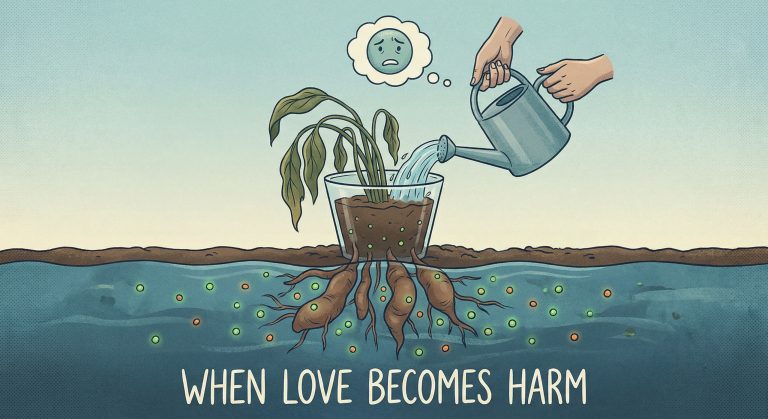
5. Dependency and control. Dependency is control wearing a softer costume. It shows up as manufactured helplessness, refusing to learn finances, or technology, or how to sit with your own emotions, so that the weight quietly shifts onto someone else. “I need this person, or I am lost.” “I need this small comfort every day, or I won't have a good day.” But the moment your wellbeing is placed in someone else's hands, you will, without meaning to, start trying to control them, to make them behave in the exact way that keeps you feeling safe. That is not love. That is insecurity, wearing a relationship as its costume. And the smallest thing they say or do that threatens your sense of wellbeing will set the whole mechanism off.
Based on the Teachings of Dr. Tina Rampadarath