The Inner Journey: Polishing the Mind to Discover Who You Are
Where knowledge takes place
The inner journey takes place in the mind. This is where knowledge takes place, and nowhere else. You are not going to discover your true nature out there in the world. That is why you have to learn to look inside and understand mind.
The more you expose yourself to the teaching, the more the understanding grows. But the teaching lands on a relatively composed mind, so the mind has to be worked on.
A relatively composed mind
Emotional maturity is a huge word, but it simply means a relatively composed mind. Think of a mind that has slipped into depression, or one where anger has taken over the whole intellect. Neither can hear the teaching clearly.
Notice the word relatively. No one has a mind that is 100% perfect, 100% pure, 100% worked out. It only needs to be composed enough to grasp the teachings.
Learn to manage your emotions. Learn to have a relatively conducive mind, to operate in this world. Otherwise, life is can be very difficult. Just think about it quietly: how well do you know your own mind?
Three ways to polish the mind
Polishing the mind means making it a conducive tool. Three methods help, each backed by Vedanta.
- Inner child work. This technique comes from psychology, and it is used here alongside Vedanta, not as pure psychology. It helps you resolve emotions and make peace with your past, with people, and with whatever is happening in your life right now. You learn to surrender.
- The 12-step program. It pairs beautifully with inner child work because it teaches you to surrender the ego. Ego here does not mean pride. It is ahankara, the sense of “I” and “mine”: I am sad, I am sorrowful, my house, I am feeling this.
- Meditation. A simple and beautiful technique to manage thoughts. You learn to witness one thought after the other.
Ahankara is not wrong. It is something you learn to use intelligently so you can keep relating to the world. When the body is hurt, ahankara says “my body, it belongs to me”, and the hurt can swell into suffering, blown out of proportion. Once you learn the teaching properly, you can put a distance there. The body is hurt, so I do what needs to be done. It’s okay. I am not hurt; it’s the body. It belongs to me because it is my upadhi, the instrument I use, so I take care of it.
As for meditation, it depends on your commitment. Provided you are committed, this much is certain: you will see the thought rising, and you will see it resolving.
“Mine” is not “me”
Vedanta says that you are not the body and you are not the mind. Your true nature is awareness, the awareness that witnesses the mind and witnesses the body. You are given a physical body; the subtle part is the mind; and your very true nature is the awareness that is conscious of what happens to both.
It is pure logic. You say my body, my car, my house. Are you the house? No, it’s mine. So if the body belongs to you, can it be you? If the mind is yours, can you be that mind? For something to belong to you, there must first be a you. This is the crux of Vedanta.
The body goes through so many changes. It’s the body that is changing form, not I. I witness what is happening to the body. That awareness, the conscious being that you are, is ever present and changeless.
Once you know this, you put a space in between. You witness, and you don’t get overwhelmed or carried away. When someone criticises you or doesn’t accept you, it is said to the body and the mind. It’s not you. The mind is upset; I am not upset. That is equanimity.
Have you ever thought of saying “my mind is upset” or “my mind is so happy”? No. You say “I am upset”, “I am so happy”. Whether or not you believe in past births, you have always identified with the body and the mind. That is why you expose yourself to Vedanta: to know you are not that body and not that mind, and to slowly move away from that erroneous identification. And this happens by knowledge alone.
The bucket list that never ends
Why should you discover your true nature? Because every action you take is already an attempt to find that content and fulfilled self. Have you ever sat down and asked yourself why you are always looking outside to do something? Look at your bucket list. The house, the next goal. Once it’s done, there is a moment of “I’ve completed it!”, and the happiness is momentary. Then the struggle starts again.
You seek for objects, relationship and money because you want your true nature, which is already fulfilled and content. Of course you will be happy when you buy a house, but the happiness is not lasting, the seeker is not gone.
No object pleases everyone, and no object pleases anyone all the time. Think of a garage sale. Something that once delighted you no longer pleases you, and now it becomes someone else’s pleasure to acquire. So how can your contentment lie in an object?
And for every pleasure there is pain. Picture parents overjoyed at the birth of a child, then imagine the pain if they lose that child. The pleasure turns into extreme pain. Every object and experience is impermanent, with an arrival and a departure, an expiry date. So you can’t depend on situations to be content.
You still have to be secure and comfortable in life; nobody is saying otherwise. Just know from the very beginning that objects will not give you the lasting fullness you are seeking. The mind gets what it wanted, the seeker and the sought blend together, and for a moment the seeking stops. Then it reorganises itself around needing something else.
You are already what you are seeking
You are already what you are seeking. You are already that content, peaceful, conscious being.
So why don’t you see it? Ignorance is the biggest problem. You are ignorant of your own nature, perhaps for a whole lifetime, perhaps for many births. Vedanta teaches that you were never bound in the first place. There is nothing to acquire and nothing to gain. Your goal in life, moksha, is to discover your true nature that is already there. This is the beauty of Advaita Vedanta.
As long as you see yourself as that body and that mind, you will feel small and insignificant, and you will turn everything into suffering. When something disturbs you at work, the same applies: if it is important, take it. If you can learn something, fine. No need to bring it to the “I”. The “I” is the witness, content, untouched by good and bad.
Long exposure to the teaching does not guarantee understanding. The knowledge is subtle, and you have to inquire into it deliberately. For the teaching to really take place, you need a relatively pure mind, a prepared mind that can question everything. Then you can truly say: the body is acting, the mind is upset, the mind is happy, and my true nature is untouched.
If you have just begun, let your aim be simple: I want to know the mind. Otherwise someone breaks up with you and you are very sad. Someone hurts you and you are sorrowful. Someone says something at work and you are utterly disgusted with your job. So that you don’t keep landing in troubled situations, learn about the mind.
Two gifts: intellect and free will
Animals breathe as you do. They are conscious beings, and so are you. So what’s the difference, and why can you discover your true nature when they cannot? Because you have been gifted two things: intellect and free will.
Humans make lists and go all the way to the moon, because everybody is seeking to be happy. Everybody wants to achieve something, everybody wants perfection, because it is your very own nature to be content and fulfilled. An animal doesn’t carry all this; it simply goes on with life. Complexes and ego belong to humans. They can be very painful, and they can be very useful too.
Your true nature is not something to be gained. At any age, whenever you are ready, you are ready. Use your intellect as an advisor and your free will to drive you on the right path. Both operate in the mind, and the ignorance is deeply rooted there as well. So use your free will to want to discover your true self.
Soak like a rasgulla
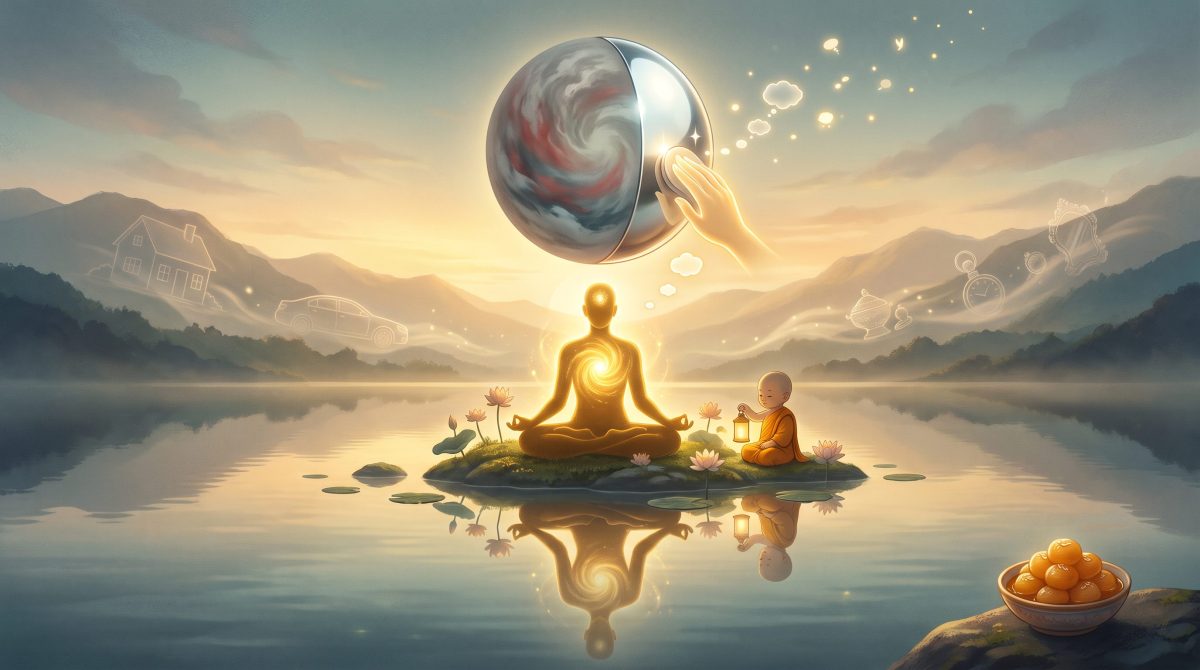
Discovering your true self is not rocket science. You don’t need any superpower. You have to do your sadhana, your spiritual practice and you have to be committed and stick to the knowledge. Be like a rasgulla, the Indian sweet soaked in syrup: soak yourself in the knowledge, and you will discover it.
The mind is the instrument for this knowledge, and the intellect is its major tool. The mind is easily clouded with emotion, which is why the intellect is held at a higher level. When you expose yourself to the teaching, you are really exposing the intellect, because that is where the knowledge takes place.
So the work is to understand the mind: its different types of thoughts, how to clean it, and which tools to use. Get to know it, make it a clean place, and the knowledge will have room to take place.
Based on the teachings of Dr. Sillma Rampadarath