

The Loss Isn’t What Hurts Most. Here’s What Does.
Perhaps you are reading this because you have lost someone. Or something. A parent, a marriage, a job you gave years to, a future you had quietly counted on. Whatever it is, you know the weight I am talking about.
No one is spared this. Loss is simply part of being alive. But there is something the Vedānta tradition asks us to look at closely, and once you see it, it can change how you carry your sorrow: the loss itself and the suffering you feel about it are not quite the same thing.
This does not mean your love was wrong, or that your tears are a mistake. It means there may be some suffering you are carrying that you do not have to carry.
What is grief?
In Sanskrit, grief is called śoka. It is sorrow, emotional suffering, that is centred on yourself.
We usually think of grief as the painful event itself. But look a little closer. Grief is really the particular way you think about that event. Listen to your own mind in a hard moment and you will probably hear something like, “This should not be happening to me.” Or, “My life cannot be whole without what I have lost.”
Everyone has them. But they are worth noticing, because this is where much of the suffering lives.
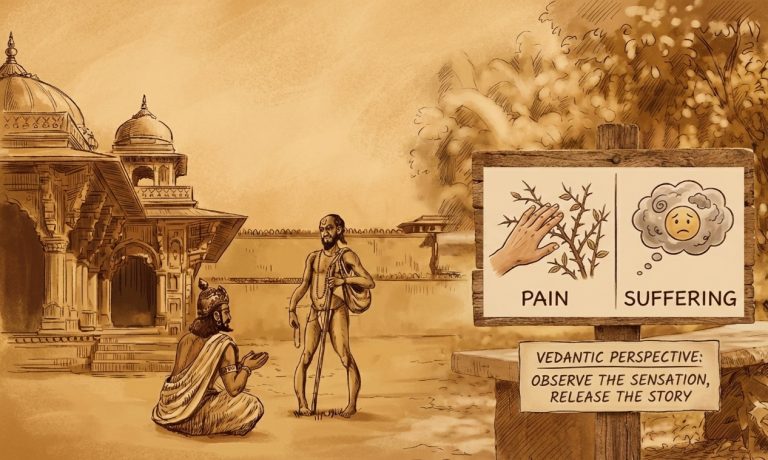
Pain is not the same as sorrow
Painful things will come in life. Illness, death, separation, disappointment, loss. No one can arrange a life without them, and the pain they bring is real. This pain leads to sadness. Sadness
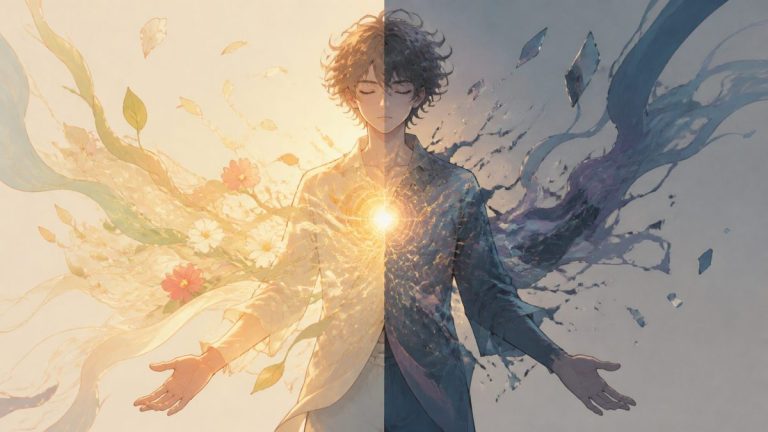
Sorrow is something else. Sorrow is what the mind adds on top of the pain: the complaining, the resistance, the self-centred thinking. “Everyone else is well, but I am not.” “This must not be happening.” The pain arrives on its own. The sorrow, we keep building by allowing the mind to construct stories around the event.
Think of a death in the family. It is painful, because you were attached to the person. There was an emotional connection. Crying is not wrong, not at all. However deep the pain feels, it has to be dealt with intelligently. Do not allow the mind to convert the pain into suffering.
Think of losing a job you held for many years, this also is a source of pain. The fact is simple enough: “My position has ended.” The pain is real, because that work gave you security, a daily routine, even a sense of who you are. But notice how quickly the mind adds more. “I am a failure.” “Everyone else is moving ahead but me.” “I will never find my place again.”
The job loss is the event. The sorrow that keeps coming back, night after night, comes from those added thoughts.
Grief wears many faces
We tend to think grief belongs only to death. It does not. It can follow almost any loss, including the quiet ones that nobody sends flowers for:
- Relationships: a divorce, a breakup, a family member you no longer speak to, a close friendship that slowly ended.
- Health: a serious diagnosis, a chronic illness, a disability, or simply the gradual changes that come with ageing.
- Work and role: losing a job, retiring, or watching a business you built not succeed.
- Life changes: children leaving home, moving away from a place you loved, or starting over in a new country.
- Hopes and plans: infertility, pregnancy loss, or a future you had expected that never came.
- Pets: the death of an animal who was part of your everyday life.
In every one of these, the pattern is the same. A fact has changed, and the mind resists that change.
How grief builds: from event to story
Grief rarely stays the size it started. It grows, and it usually grows in familiar ways. You go over the painful situation again and again, in conversation or alone in your head. You remember something you loved and lost, and you tell yourself, “Right now I do not have that.” You want something and do not get it. Or you are stuck with something you never wanted.
Little by little, the mind builds a story around the original event. A layer of “should or could.” A layer of self-blame. Then fear, then hopelessness. One painful thought brings the next, and the next, until you can no longer see what is still working in your life.
This kind of thinking has a name: rumination. It is the mind replaying the same scene and rehearsing the same conversations, over and over, without ever leading to anything useful.
So grief is not simply, “Someone is gone,” or “Something changed.” It is the mind holding on, again and again, to what has changed, and refusing to accept that it has.
Pain, Grief, and depression
These three often get mixed up. They are related, but they are not the same. What separates them is not so much the feeling itself as the thinking that gathers around it.
| Experience | What it is | What usually happens |
| Grief | Sorrow connected with loss, separation or death | You feel the absence of someone or something you love |
| Pain | A changing emotional state involving painful thinking | It may come from disappointment, rejection, loss or an inner vulnerability |
| Depression | A persistent, overpowering pattern in which sorrow and discouraging thoughts dominate | The mind becomes difficult to manage and ordinary activities become hard |
Grief: sorrow
If a stranger's mother dies, you may not cry. If your own mother dies, you grieve, because there was love, there was a relationship. Loss brings sorrow only where there is attachment.
So please hear this: sorrow is not a mistake. It is not a sign of spiritual immaturity. A healthy human being responds to loss, and it should. Healthy grief makes room for feeling, for expression, for reflection, and in time it lets you return to your life. Grief becomes unhealthy only when the mind keeps ruminating and spins a discouraging story around the loss.
Healthy grief
A woman lost her father three months ago. Every morning she sets out two cups of tea and thinks, “It's my fault. I should have visited more.”
After some weeks, she realises she is thinking herself into grief. She starts working on herself and seeks help:
- When “It's my fault” arises, she asks, “What actually happened, and what am I adding?”
- She writes down her repeated thoughts to see the pattern.
- She walks their evening path again, remembering him with love.
- She talks to a close friend.
- She sees a grief counsellor.
Slowly, the sorrow lightens, and she returns to life.
Unhealthy grief
A woman lost her father three months ago. Every morning she sets out two cups of tea and thinks, “It's my fault. I should have visited more.”
She never questions these thoughts. Months pass. She stops meeting friends and feels guilty when she laughs. “I failed him. There is no point.” She struggles to get out of bed and loses interest in everything.
Her grief has become depression. She now needs compassion and professional support.
Depression: when sorrow becomes the pattern
Depression is not simply ordinary sadness. It is a condition in which the mind has become hard to manage. Sorrowful or distorted thoughts have built up over time, because a thread of thought was left unattended for too long.
Here is the difference. With sadness, a painful thought or feeling arises, and you are able to let it pass and return to life. With depression, the thoughts become dominant, repetitive and discouraging. You struggle to pull yourself up, and you may find you cannot do the things you want to do.
This is why telling yourself, “Don't be sad, be cheerful,” usually does not work. You already want relief. The problem is that the mind has developed a powerful pattern. Depression deserves compassion, honest inquiry and the right professional support. Never condemnation.
In depression: Months pass, and she never questions her thoughts. She stays in bed until noon and calls in sick to work. The two cups of tea sit untouched on the table for days. She ignores her friends’ calls, barely eats, and lies awake at night replaying “It’s my fault” again and again. She avoids the evening path and has given up the reading and gardening she once loved. Her grief has quietly turned into depression, and she now needs compassion and professional support.
Notice that the same kind of loss could lead to different emotional outcomes. What makes the difference is how long the feeling lasts, how much the repeated thinking takes over, and whether ordinary life can carry on.
Emotions are indicators
Each emotions points at something. Fear usually points to some danger you are imagining in the future. Anger points to a sense of injustice. Sorrow points to love, and to loss.
Sometimes an emotion is also tied to something older, an experience from the past that was never fully resolved. Have you ever overreacted to something small and wondered afterwards why it hit you so hard? Often it is because the present moment touched a tender spot from long ago.
So what do you do with an emotion? The mature response is acknowledge it and do not suppress it. Take time to investigate it. You look at it honestly and ask what it is pointing to. And as you do, you will find the emotion slowly loses its hold over you.
A closing thought
The aim here is not to stop feeling, and certainly not to love less. The aim is to see clearly the difference between what actually happened and the story your mind keeps telling about it.
So the next time sorrow rises in you, pause for a moment and ask gently: What has actually happened? And what am I adding to it? You may be surprised how much space that one question can open up.
And if your sorrow has stayed for a long time, if ordinary life has started to feel too heavy to manage, please do not carry it alone. Speak to someone you trust, or to a counsellor. Asking for help is not a weakness. It is a way of caring for yourself.
Based on the teachings of Dr. Sillma Rampadarath


My appreciation goes to Dr Sillma Rampadaruth, who is actually doing a great job. We should be grateful to have such a young person involving in in the teaching of Vedanta which is very helpful to us..Hopefully she will emerged on this field for the benefits of the while nation in the near future
Gongratulation to you TINA