
Bend, Don’t Break: The Yoga of Objectivity Toward Emotional Maturity
Emotions make or mar our life
“Life is made of emotions. Emotions make marriages; they also break them. Emotions create sane people and insane ones too. Therefore, it is very important to understand the nature of emotions. It is emotions which makes or mars our life.”
For this reason, objectivity towards your emotions is fundamental. It allows you to understand what you are going through.
You may struggle with low self-esteem, fear or insecurity. When these emotions are not recognised, they bring a great deal of suffering.
Your emotional life often follows a yoyo pattern. When things work out as you wish and those close to you behave as you want, you are elated. When you face hardship, or those close to you do not meet your expectations, you crumble in sorrow.
Some things will work out and some will not, and emotions will arise accordingly. How you choose to work on those emotions, however, is in your hands.
You pass through many emotional states in a single day. They are meant to be dealt with through understanding.
The reed and the tree
A storm can uproot great trees because they do not bend. Yet the same storm cannot uproot the reeds on the riverbank, because they bend as the wind strikes and then come back. In the same way, you can use your free will to choose your path. With emotional objectivity, you become like the reed; without it, you remain like the tree.
Emotional objectivity is not avoiding or running away from emotion, nor is it becoming over-elated in pleasant situations. It is learning to deal with situations with equanimity.
Equanimity is the quality of the reed, which bends and adjusts to the wind. It does not mean remaining untouched when things are falling apart; it means learning to bend so that you do not break.
Pleasant and unpleasant situations cannot be avoided. Life is made of situations unfolding every minute, and each carries a certain emotion. The aim is not to stop feeling, but to stop resisting what you feel, simply acknowledging your emotions and that you are powerless over them.
The reed takes the full force of the wind, yet it does not snap and does not stay bent. You, by contrast, may often stand stiff like the tree, insisting that the wind should not be blowing.
On examining your life, you will find that the greatest suffering came in situations that did not turn out according to your expectations. Such situations are very hard to accept, and they bring thoughts such as “This should not be happening to me” or “I should not have to feel this.”
The world in our head
Objectivity is facing what is. The main difficulty is that, instead of taking a situation as it is, you hold a preconceived notion in your mind of how you want it to be.
You tend to create strong expectations of the people around you, and surprisingly, even of strangers. The closer someone is to you, the more definite and prominent these expectations become.
A husband comes home and goes straight to his phone. His wife’s first thought is: “He should ask about my day. He doesn’t care.” What actually happened is only that he picked up his phone; “He doesn’t care” is her story. Meanwhile, he may be thinking: “She should give me a few minutes to unwind.” There are two pictures of how the other should be, and both feel hurt.
The mature response is: “I wanted him to ask about my day. He didn’t. That’s all that happened.” She may then simply say: “Can we talk about our day after dinner?”
A manager gives feedback on a report and points out three mistakes. The employee thinks: “She should appreciate how hard I worked. She always finds fault with me.” What actually happened is only that she pointed out three mistakes; “She always finds fault with me” is his story. Meanwhile, she may be thinking: “He should check his work more carefully before sending it.” Again, both end up frustrated.
The mature response is: “I wanted her to notice my effort. She focused on the mistakes. That’s all that happened.” He can then fix the errors and, if he wishes, ask: “Was there anything in the report that worked well?”
When two sets of “shoulds” meet
You think you know exactly how a brother, a sister, a spouse or a child should behave. Yet you tend to forget that they equally hold expectations of how you should be.
When two sets of “shoulds” meet, relationships become high maintenance. They become emotionally complex, and both parties can easily hurt each other, each convinced they are correct from their own point of view, a view held in the mind.
Every situation, when it takes place, has two components:
Facts + Expectations = high maintenance. If you choose to remain with the facts alone, you have a better chance of not dragging yourself into hurt and sorrow.
The hurt you feel when a loved one disappoints you is often not caused by what they did. It is caused by the distance between what they did and the picture you held in your mind in the form of expectation.
You live not only in a world out there, but also in a world within your mind. Your emotions tend to react to that inner world, with its expectations and verdicts, more than to the person actually in front of you.
Holding expectations lightly
This does not mean giving up all expectations, becoming someone with no emotions, or being merely a witness. What is meant is the following:
- Hold your expectations of anyone lightly, lightly enough that the relationship can breathe.
- Recognise that the other person is operating under their own pressures: their own likes and dislikes, their own inner child.
- Before your mind runs with its stories, recognise that the other person also holds expectations of you.
What is given, and what is mine
What is given is not yours. It belongs to the laws of nature, the laws of creation, or, if you wish to name it so, the Lord’s creation. Your body is given, your mind is given, and the family you are born into is given.
Understanding and accepting what is given, with whatever attributes it has, makes you a great deal more objective in life. What is given is simply how things are, but you can use your free will to refine your responses. This is where your work lies.
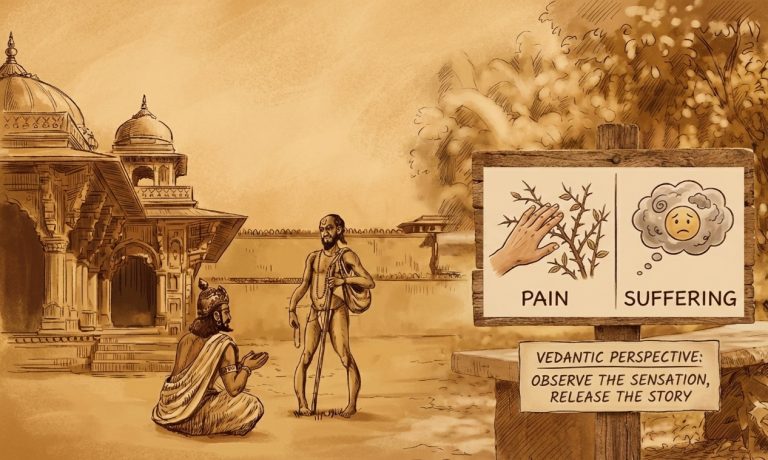
Roses come with thorns
You may like roses, but you do not really like the thorns, which make the flower unpleasant to hold. You begin to wish for roses without thorns. In the same way, you want the world to be to your liking.
Every person, thing and situation you encounter comes with its own thorns. Understanding this can bring great relief to your emotional well-being.
Looking deeper, you will see that these thorns may come from a loaded unconscious or a hard childhood, and that people often react in this way as a protective mechanism. Their thorns are their armour.
The less you take these emotional lashes personally, the more inner freedom you have. It is never about you; another person’s overreaction is not your responsibility. With this understanding, you stop expecting roses without thorns, and you stop being freshly wounded by every thorn.
Doing my part without inner upheaval
In a very difficult situation, it is natural to do everything in your capacity to get out of it. This is not passivity; it is what planning and intelligent living are.
That you must work to bring about change is not negotiable. But you cannot bring about every change you desire. That is simply a reality.
The trouble begins in how you respond to this second fact. More often than not, the response is subjective: the agony, the regret and the frustration of being unable to accept the reality despite all your effort.
One of the most freeing understandings is that life is built of pairs of opposites, and that this too shall pass. No one is in trouble only. A problem is here to teach you something, to help you grow in tolerance and to make you tougher through experience.
You need not undergo these inner upheavals. You can face things squarely, without going yoyo with your emotions.
You can pray, consult an astrologer to understand what is happening, or perform a shanti puja. But you are not in charge of the outcome. You can only do your best.
I am not in charge of outcomes
There are many hidden variables in every situation. You cannot control even the known ones, let alone the hidden ones; you do not call all the shots.
This changes the emotional weather in two directions. It eases self-blame, the endless “if only I had…”, because much of what happened was never in your hands. It also eases the blame of others, because they too were acting among variables they could not see.
What remains is clean effort, without the heavy residue of regret.
References: Pujya Swami Dayananda's classes
Based on the teachings of Dr. Sillma Rampadarath