
Insecurity, Fear & Hurt
The Big Idea
Insecurity, fear, and hurt are not the same thing, even though we tend to lump them together as “bad feelings” we'd rather not have. Insecurity is a conclusion we've drawn; it lives at the level of self-understanding. Fear is an emotional response; it lives in the mind, in manas. Hurt is stored pain; it lives in the unconscious, out of our conscious reach. Because these three operate at three different depths of the person, we cannot address them as one flat idea.
The Root: Insecurity
Insecurity is not about lacking something. It is the unexamined conclusion that “I lack.” As Swami Dayananda puts it, “Security is not the problem. That I lack something is not the problem. The problem is ‘I' lack.” The wound is not in the object that seems missing; it is in the Ego that has quietly decided it is incomplete.
Once that conclusion is in place, we start to feel like victims (of a spouse, a government, a boss, society) and we go looking for security in objects that are themselves insecure. This is where the logic breaks down, and it is worth walking through slowly:
- You are insecure.
- What you think is secure is just as insecure as you are.
- Therefore, insecurity plus insecurity does not add up to security. It only doubles the insecurity.
Two insecure people marrying each other for the sake of security is a vivid example of this: can there be a greater hell anywhere?
Insecurity tends to show up in one of two ways. There is the superiority type, which doesn't feel good about itself and so compensates by presenting as bigger than it is, hungry for acknowledgment. And there is the inferiority type, which turns inward as constant self-criticism: “I am useless.” Both share the same root sentence: I'm not good enough. Over time, this creates a dependence on other people's recognition, until the dominant question running in the background of the mind becomes: How am I being perceived, right now?
The Expression: Fear
Wherever insecurity is, fear follows close behind. Fear itself operates on three levels. At the level of the body, it is terror. At the level of the mind, it is anxiety. And underneath both of these sits insecurity itself. Most of what we experience day to day is not terror; it is the quieter, more persistent hum of mind-level anxiety.
Fear tends to arrive by way of a chain: attachment leads to fear, and fear leads to anger. Unhealthy attachment is a dependence on something outside yourself for happiness or comfort; you believe this object or person will be the source of your happiness. When that attachment is threatened, fear arises. And once fear arises, anger follows, rushing in to protect the attachment. Attachment and fear are two sides of one coin, directly proportional.
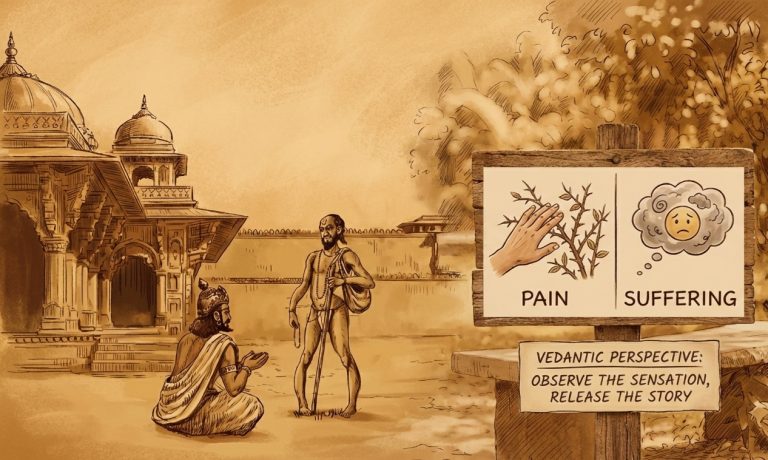
It helps to distinguish two kinds of fear. Instinctive fear is the fight-or-flight design that keeps the body alive, like pulling your hand from a fire, or fleeing a tiger. This is biological wisdom, and it is doing its job. Psychological fear is different: it is projection, not present reality. It hijacks free will and skews our choices away from our own best interest, showing up as scarcity narratives, catastrophizing such as fear for a child's future, or clinging to a toxic job or relationship out of fear of losing whatever security it seems to offer.
Fear also wears many faces, and it's worth learning to recognize them in ourselves: paranoia, which imagines a threat where none exists; over-confidence, which is often just denial dressed up as “I am fearless,” compensating for unresolved fear underneath; a cynical lack of trust, which assumes people won't honor their word and keeps us on guard like a stressed-out ninja; and anger itself, which, because it is fearful, cannot take in or assimilate a larger vision.
The Residue: Hurt
Hurt is the stored pain of the past that continues to shape how we feel about ourselves, other people, and the world. In trauma, especially childhood trauma, pain is placed in the unconscious. But the pain doesn't disappear simply because we can no longer recall it. It keeps shaping perception. As adults, we don't see situations objectively; we see them filtered through this old, unconscious distortion. This is the root of feelings like “nobody likes me” or “nobody wants me,” and of the exhausting patterns of seeking approval or needing to prove oneself again and again.
The cycle looks like this: past hurt settles in the unconscious. That hurt breeds insecurity, a felt sense that love, or people, won't stay. Insecurity generates fear, fear of opening up, fear of being hurt again. And fear produces defense mechanisms, such as pushing people away before they get close, as protection against a repeat of childhood abandonment.
Worry, anxiety, and panic are born of this unconscious- the inner child. This is what is meant by viparīta-bhāvanā, a condition where our experience runs opposite to what we actually know, purely as a residue of childhood. Present-day events are very often just triggers for these old, unresolved issues, which is exactly why an adult's anger at some small event today can be wildly disproportionate to the event itself.
The Common Root: Ignorance
Here is the move that draws insecurity, fear, and hurt back into one thread: anātmā is never secure, and ātmā is never insecure. The root cause of all three is ignorance, the mistaken thought “I am a jīvātmā,” a limited individual.
To identify with the body-mind instrument is to inherit its limitations. The body is insecure: it is subject to microbes, to age, to time, and will one day “join the majority, the dead.” The mind is fearful, driven by rāga and dveṣa, attachment and aversion. And the unconscious is hurt, carrying the residue of past trauma. If the ātman is taken to be identical with the body, it inherits the body's ageing and illness, and insecurity follows naturally. The problem was never that these limitations exist. The problem is that they are wrongly attributed to what is, in truth, limitless.
Practical Steps To Prepare You For the Ultimate Solution
For insecurity, there is bhakti: trust that Īśvara “has your back” at all times, and the surrender that comes with that trust. This trust is itself a form of knowledge; it lets a person let go of worry, and in letting go, feel the love they already are.
For fear, ask yourself: is the fear me, or am I the one witnessing the fear? Try see that the feelimg of fear belongs to the mind: “Fear are thoughts arising in the mind, I'm capable of dealing with it. I can find solutions using my intellect.” Trust life: the world isn't here to hurt you; as long as you follow dharma, there is little to fear.
For hurt, there is a writing exercise. First, write out past hurtful events in full, vivid detail, including the feelings involved. Then write a second pass, re-understanding the same events through the lens of order, Īśvara's order, rather than randomness or injustice. Writing works at a deeper level than merely thinking things over.
The Ultimate Solution: Self-Knowledge
The remedy is not more external security, the absence of fear, or the erasure of hurt. The remedy is self-knowledge. The only real security is knowing oneself to be secure; the wise person needs no external prop.
Vedānta's answer is direct: I am not the body, not the mind, not the unconscious. I am Turīyam, without a second thing. And if there is no second thing, there is nothing left to hold onto, and nothing that needs to be held onto. Security is one's very nature.
The Final Vision
Mokṣa is freedom from sorrow, desire, and fear, and this freedom shows up as a discernible change in one's own state of mind, not as an abstract doctrine.
“The lion cub brought up in a flock of sheep will run away from a fox. But when it realizes its identity as a lion, fear goes. Concrete knowledge of one's identity removes apprehensiveness and hesitation.”
Where, in your own life, have you been behaving like a sheep out of a forgotten identity?
For Reflection
- Where in your life do you notice the attachment leading to fear leading to anger chain playing out?
- Can you identify one psychological fear, a projection, that you're currently treating as if it were an instinctive fear, a real and present danger?
Based on the Teachings of Dr. Tina Rampadarath