
The Importance of Ishvara in Life
What is Ishvara?
The world of forms and names that surrounds us is not a random collection of things. It is organized intelligently. Every form is intelligently put together, down to each assembly. What's more, each form is interconnected, having a meaningful relationship with everything else. Therefore, an all-knowledge, all-power organizes this world and governs the interactions within it. This all-knowledge-power is Ishvara.
Knowing this intellectually is not enough. You need to incorporate the fact of this all-knowledge-power into your actual life, because you are constantly surrounded by forms and names. Only when you do this will your interactions with the world change. You start to live responsibly, intelligently.
Why Bringing Ishvara Into Life Matters
Why is bringing Ishvara into life important?
Because things don't always go our way. There are internal and external challenges that we constantly have to deal with. If we don't recognize that everything is governed by an order, it becomes far more difficult to cope with them.
Without this recognition, we tend to fall into complaining and criticizing. This only hurts us, because it robs us of our happiness. This is why we need to refine our thinking, so that it becomes more aligned with the grand order. Just as you need to align your body to food, for the body to function, you need to align your thinking to Ishvara, for your life to function well.
The World as a Friend for Self-Growth
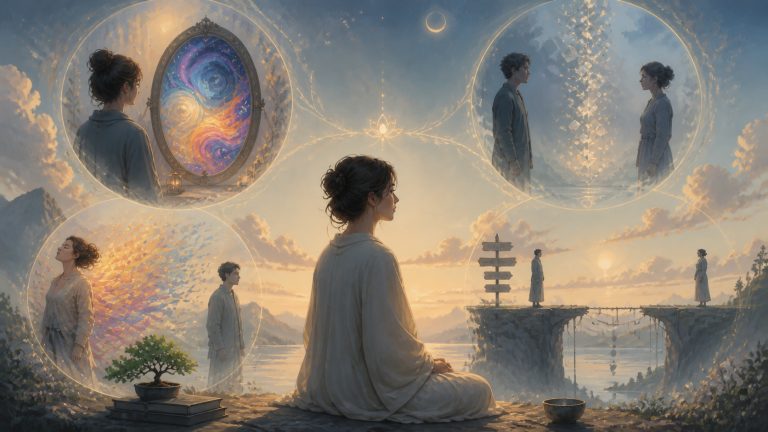
Once this understanding is clear, the world of forms stops being an obstacle and becomes an opportunity. It gives you the chance to undo disempowering patterns of thinking. The world serves as a mirror, giving you clues. It shows you which situations throw you off, and where you remain composed.
This means spirituality is not about leaving the world behind. It is about leaving behind old, mistaken perspectives about the world.
Acting in Harmony With Dharma
Living in accordance with Ishvara also means acting in harmony with the order of dharma, the universal values that are commonly sensed and accepted by everyone, and which form the basis for our behavior in society. Nobody wants to be cheated, lied to, or hurt. We also know that others don't want this either. Regardless of where you come from, everybody is endowed with this knowledge.
The problem is that we struggle to adhere to these universal values. The more we fail to act in harmony with dharma, the more guilt, shame, and inner conflict build up. These feelings make us unavailable to ourselves and to the world, because our mind's power ends up fixed either in the past, dealing with old wounds, or in the future, trying to avoid facing them. In either case, contentment is denied.
Dharma as a Law
The Vedas describe dharma as a law, meaning it cannot be disregarded, because it exists just like gravity. Every cause produces an effect. Everything counts, whether or not we choose to see it.
So following dharma has nothing to do with appearing good to others. It comes from understanding: “I don't want to be burned by violating it.”
Conclusion
Bringing Ishvara into life is what allows knowledge of the Self to actually reflect in our thoughts, decisions, and actions. Without it, we remain at the mercy of our own complaints and criticisms whenever life doesn't go our way. With it, we begin to see the world as an intelligently governed order, one that can be used as a mirror for our own growth, and one whose laws of dharma we align ourselves with, not out of fear or appearances, but out of genuine understanding.
Based on the Teachings of Andre Vas