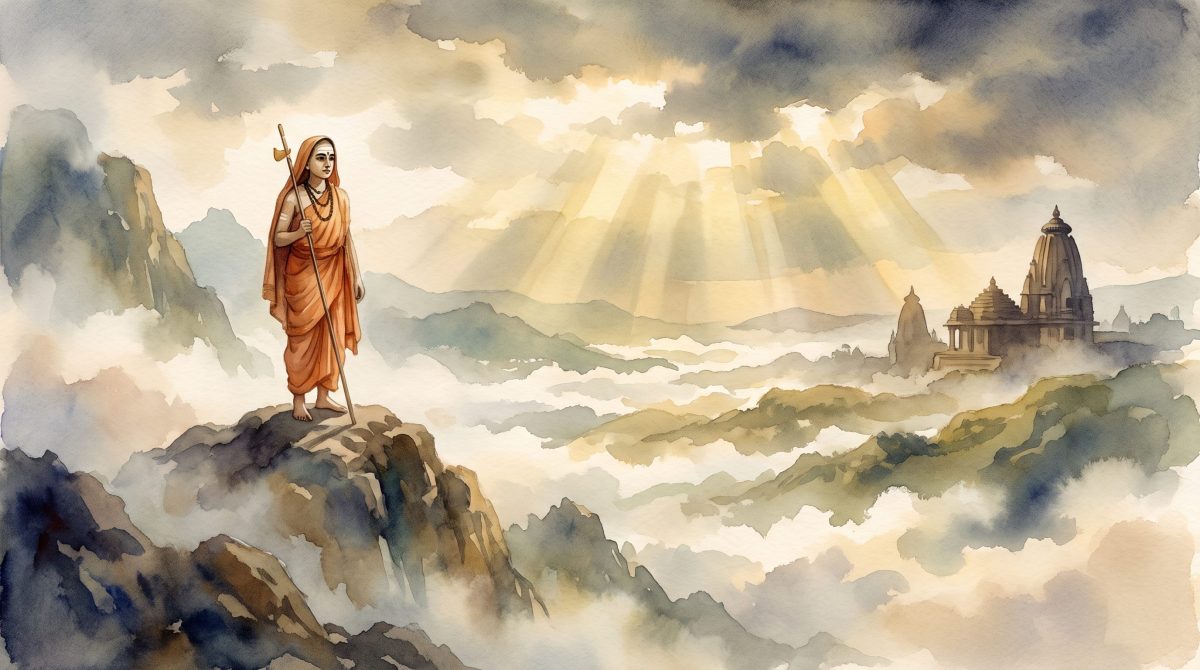
Adi Śaṅkarācārya: A Journey Through Knowledge and Liberation
Introduction
Adi Śaṅkarācārya stands as one of the most consequential teachers in history. Scholars generally place him in the early eighth century CE, with tradition commonly dating his life to 788–820 CE, though the exact dates remain a matter of scholarly debate. He gave systematic shape to Advaita Vedānta, the non-dualist teaching that the individual self, Ātman, and the ultimate reality, Brahman, are not two but one. The tradition regards him as an incarnation of Śiva. “Śaṁ karoti iti Śaṅkaraḥ”—he who brings about maṅgalam, an auspicious end. Adi Śaṅkarācārya is held to be the one who brings that chain to its close, not by adding another link but by dissolving the ignorance that forges it. It is on this understanding that he is worshipped as Śiva himself, the remover of ignorance and of the suffering that ignorance produces.
He was born in Kāladi, a village in present-day Kerala, and grew up speaking Malayalam. The traditional biographies describe a childhood of startling precocity: Sanskrit mastered by three, the Vedas known by five, formal study completed by seven, and renunciation, sannyāsa, taken at eight, an age at which most children have barely begun their education.
Legend adds a further layer to the shortness of his life. He was said to be destined to die at sixteen, until the sage Veda Vyāsa, appearing to him disguised as an old Brahmin, drew him into a long debate and, moved by what he heard, granted him sixteen more years. It was in this second span that Adi Śaṅkarācārya wrote, traveled, debated, and built the institutions that would carry the teaching long after him.
The Written Legacy
Adi Śaṅkarācārya's central achievement was to write extensive commentaries, bhāṣyas, on the ten principal Upaniṣads, the Brahma Sūtras, and the Bhagavad Gītā, the three texts together known as the Prasthānatrayī, the triple canon on which all schools of Vedānta must eventually take a position. Before these commentaries existed, access to the deeper teaching of the scriptures depended almost entirely on finding a teacher capable of unfolding it directly; Adi Śaṅkarācārya's writing made that teaching available on a far wider scale, and in a form stable enough to be checked and re-checked across centuries.
Beyond the commentaries, he wrote independently. The Upadeśa Sāhasrī is his own topical presentation of Vedānta, composed specifically for the serious seeker. The Vivekacūḍāmaṇi is a major independent treatise on the discipline required to realize the teaching. Ātma Bodha distills the essentials into a short, foundational work. And Bhaja Govindaṃ, a devotional composition, is said to have been written after Adi Śaṅkarācārya came upon an old man in Kāśī still absorbed in memorizing the rules of Sanskrit grammar.
The Core Teaching: Adhyāsa and the Path to Liberation
At the center of Adi Śaṅkarācārya's work is adhyāsa, or superimposition. Laid out at the opening of his Brahma Sūtra commentary, the idea is this: the Self was never bound. A person can spend an entire lifetime acquiring worldly knowledge and still remain unfree, because knowledge about the world does nothing to remove ignorance of one's true nature. Only direct knowledge of the Self removes it, and that knowledge is arrived at through sustained study, reflection, and contemplation.
In the Upadeśa Sāhasrī, Adi Śaṅkarācārya describes this bondage as a wheel with eight linked parts, each one feeding the next: misapplied knowledge, ego (ahaṅkāra), superimposition, a felt sense of incompleteness, desire, action, the merit and sin that action produces, and rebirth in a body. The wheel keeps turning until it is broken, not by escaping it, but by knowledge alone. Freedom is the recognition that the ego itself is a superimposition on the Self that was always free. Someone who has this shift in understanding he becomes a jīvanmukti: liberated while still alive—freedom right now, not after death.
Adi Śaṅkarācārya's View on Ritual
Adi Śaṅkarācārya did not reject ritual, karma-kāṇḍa, as useless, but gave it a limited, instrumental role: it purifies the mind, it does not liberate. Performed with a calm, unselfish attitude, ritual brings about antaḥkaraṇa-śuddhi, purification of the inner mind, making it steady enough to absorb the teaching of the Upaniṣads.
For this reason he placed ritual under aparā-vidyā, lower knowledge, suited to those still pursuing desire and security within the bounds of dharma. Performed with attachment to results, ritual only sustains the cycle of birth and death: merit earned leads to heaven, heaven is exhausted, and the person returns. It cannot touch the root problem, ignorance of one's true nature.
Adi Śaṅkarācārya therefore advised a gradual withdrawal from ritual in favor of study, giving up prohibited and desire-driven acts first, atonement rituals later, and finally even daily obligatory duties as inquiry matures.
Building Something That Would Outlast Him
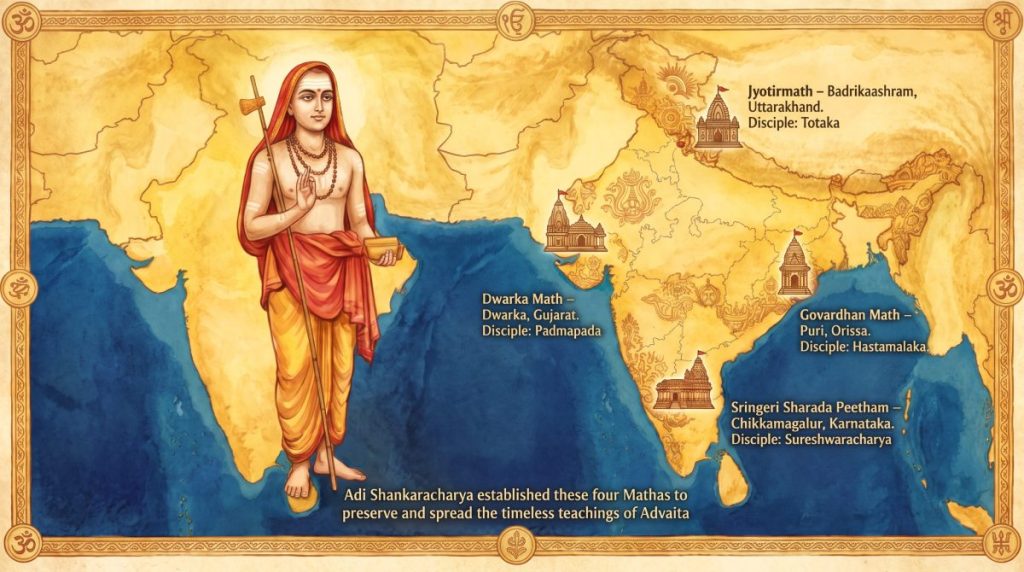
After the debates and the writing, Adi Śaṅkarācārya did not withdraw. He established four monasteries, at Śṛṅgeri in the south, Dvārakā in the west, Jyotirmaṭh in the north, and Purī in the east, and placed senior disciples at the head of each. A teaching entrusted to one person, the reasoning goes, dies with that person; an institution can carry it forward indefinitely. It is one of the more verifiable parts of his legacy: these four maṭhas remain functioning centers of teaching today, roughly twelve centuries later.
©Vyakta.org