
Why It’s Never Really About You: Three Reasons People Act the Way They Do
A guide to breaking free from blame and finding lasting clarity
We all begin in the same place. Something goes wrong, and we look outward. The world is at fault. Other people are at fault. Our parents, our neighbors, circumstances beyond our control. These become the explanations we reach for. It is the most natural thing in the world, and nearly everyone does it.
But here is the honest question we rarely pause to ask ourselves: Is that attitude actually helping me move forward?
The answer, if we are truthful, is No.
The Mirror Problem
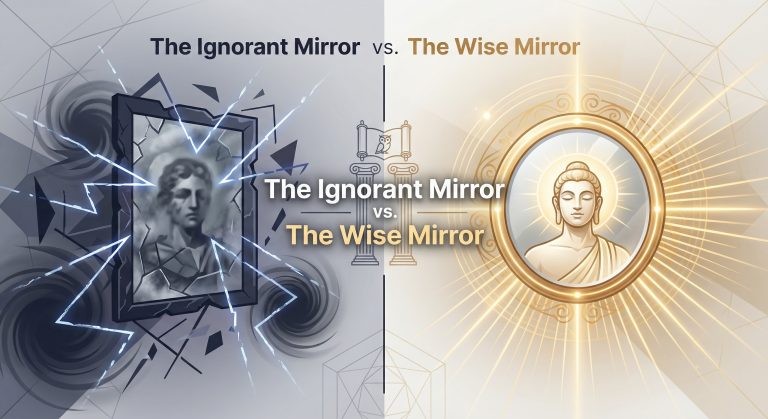
The way we experience the world is not an objective broadcast. It is a reflection. The world we perceive, how we experience our neighbors, our homes, our relationships, mirrors what is already occurring inside our own minds. The external is a preview of the internal. It is- showing us, in vivid detail, what still needs to be worked on within ourselves.
This is not a comfortable idea. It is, however, a useful one.
The first step toward freedom is simple honesty: Am I still coloring the world with my own ideas of how it should be? That tendency to overlay reality with our expectations and then feel wounded when reality fails to comply is the root of almost all interpersonal suffering.
Three Reasons People Do What They Do
Before the next conflict arrives (and it will), it helps to have a framework ready. When we are in the middle of hurt or frustration, our minds move quickly toward blame. What we need instead is a fallback: a set of explanations that are both true and compassionate, that can interrupt the cycle before it begins.
Here are three reasons that account for nearly all difficult human behavior.
1. Nobody Has All the Facts
Think of any conflict or misunderstanding you have experienced. Almost invariably, at the heart of it, was a missing piece of information. One extra thing known about you, about them, about the context, and the whole thing would have unfolded differently. Perhaps you would have become lifelong friends. Perhaps there would have been no conflict at all.
This is not an exception. It is the rule.
No one has ever had complete information about another person, and no one ever will. When someone treats you unfairly, harshly, or dismissively, there is almost certainly something they do not know about you: your struggles, your intentions, your history. And there is almost certainly something you do not know about them.
Understanding this does not excuse poor behavior. But it transforms our response to it.
Scenario: Mark is furious with his colleague, Emily, because she sent out a client email with an outdated attachment, causing embarrassment. He thinks she's careless. Emily, however, was explicitly told by a different manager (who was unaware of a last-minute change) to use that specific attachment, and she was trying to be efficient under pressure. If Mark had known this, or if Emily had known about the manager's oversight, the conflict could have been avoided entirely.
2. The Kick the Dog Effect
Psychology has a name for something we have all experienced: displaced aggression, or what might be called the “kick the dog” effect. A person carries accumulated pressures, work stress, financial strain, unresolved grief from childhood, the low-grade exhaustion of not being truly heard, and then a small thing happens. An innocent bystander, a minor mistake, a slightly too loud voice in a quiet room. And all that stored pressure releases.
The target was not the cause. They were simply present.
We live in an era of unprecedented connectivity that has paradoxically made genuine listening rarer. Social media offers a platform but sharing your real pain publicly carries the risk of judgment rather than the relief of understanding. So, the pressure builds quietly and it has to go somewhere.
When someone lashes out at you without apparent reason, it is worth asking: What are they carrying that I cannot see?
Scenario: David's boss just unfairly criticized his work in a public meeting, and he's feeling deeply frustrated and undervalued. On his way home, a pedestrian accidentally bumps into him lightly. Instead of a simple “excuse me,” David snaps, “Watch where you're going, you idiot!” The pedestrian was just an innocent trigger for David's pent-up anger from his workday.
3. The Empathy Gap
The third reason is subtler. When rules are broken, social rules, workplace rules, unspoken expectations, some people experience genuine discomfort. Their sense of order is disrupted. And in their drive to restore that order, something important is lost: they stop seeing you as a person with good intentions and see you only as someone who has violated a rule.
This is the empathy gap. Their focus narrows entirely onto the infraction. Your humanity, your context, your reasons, your character, disappears from view. You become not a person, but a problem to be corrected.
It is worth recognizing this effect in others, yes. But it is also worth recognizing it in ourselves.
Scenario: A new barista, Maya, accidentally makes a customer's coffee incorrectly. The customer immediately demands to speak to the manager, loudly complaining about the “incompetence” and “poor service.” They don't consider that Maya might be new, still learning, or having a challenging day; her mistake instantly transforms her from a person into “the problem employee who messed up my order
It Was Never About You
Here is the most freeing realization to which all of this leads: how people respond to you is almost never truly about you.
When someone is harsh, it reflects their unprocessed pressures. When someone is condescending, it reflects their need to restore order. When someone misreads your intentions, it reflects the facts they are missing, not your worth.
Even a compliment, if we look closely, is more about the giver than the receiver. We tend to praise in others what we recognize and value in ourselves, qualities we aspire to, or ones we are still developing. The compliment is real, but it is also a kind of mirror.
None of this means your feelings in response to others' behavior are invalid. They are real, and they deserve attention. What changes is the story we tell about why it happened, and that story determines whether we stay stuck or move forward.
A Different Way of Walking Through the World
The next time someone speaks to you with harshness you did not earn, or treats you with less than you deserve, try this: pause, and ask which of the three applies.
Did they lack a crucial piece of information? Were they carrying pressures that had nothing to do with you? Did a broken rule trigger their empathy gap, making them temporarily unable to see your good intentions?
In most cases, at least one of these will be true. And in that recognition, something shifts. The resentment loses its grip. The story becomes less personal. And you find that you have, without fighting, reclaimed your peace.
That is not naivety. That is clarity: the kind that takes real work to build and is worth every bit of it.
Based on the teachings of Andre Vas