Life Is Not Here to Make Me Happy: The Freedom From Disappointment
Introduction
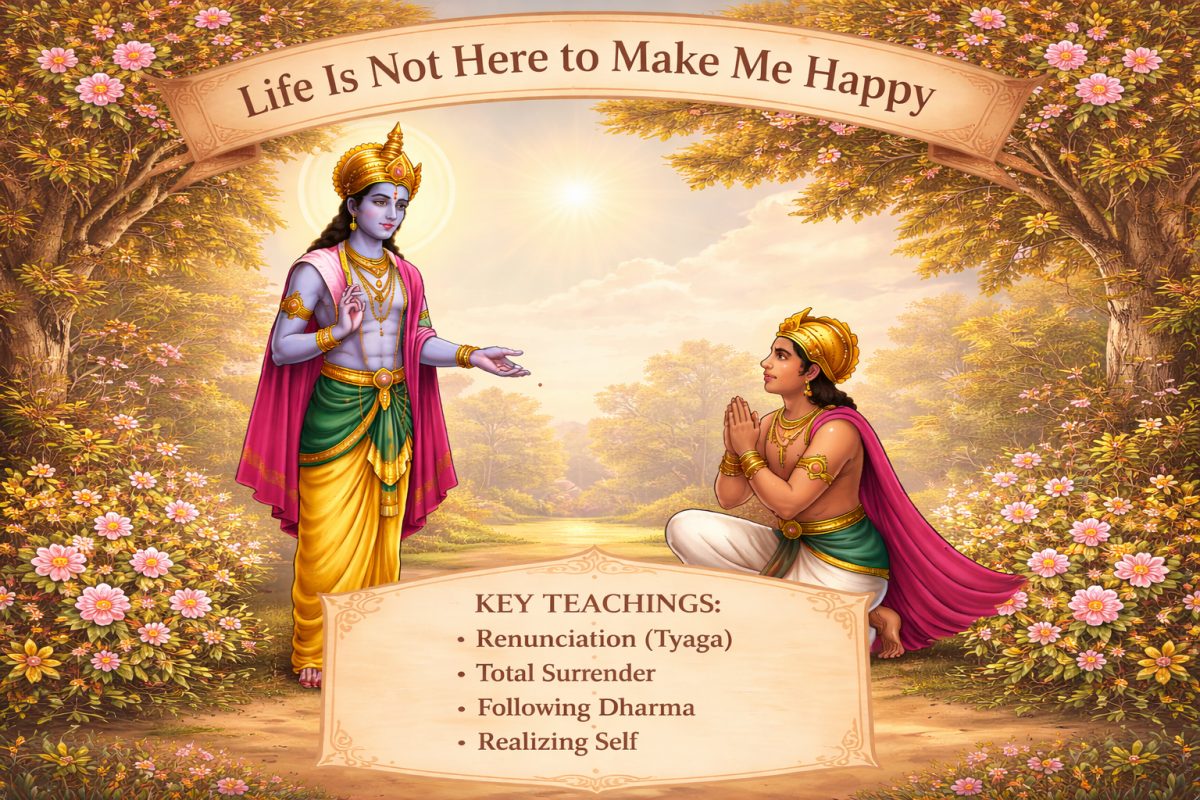
There's a profound first sentence: “Life isn't here to make you happy.” This isn't pessimism—it's the most liberating truth we can embrace. In a world where billions of people are constantly chasing happiness, yearning for life to bend to their will, this statement offers something far more valuable than fleeting pleasure: it offers freedom from disappointment.
The Bhagavad Gita, in Chapter 4 Verse 21, encapsulates a wisdom that remains eternally relevant: Krishna calls this liberation “freedom from expectation.” But it might be more accurately renamed freedom from disappointment—because the two are intimately connected. When we understand that life is not designed to fulfill our expectations, we free ourselves from the constant suffering that arises when reality fails to match our fantasies.
The Unreasonable Bet We Place on Life
Imagine this scenario: You've rehearsed a speech a hundred times. You're about to deliver it to an audience of 100 people. It's only five minutes long. Would you stake your entire house on the condition that you won't slip up a single word?
The answer is an obvious no. Yet, this is precisely what we do with our lives every single day.
Consider the larger bets we unconsciously place:
- Would you stake two years of hard work and your entire life savings on the guarantee of a promotion?
- Would you gamble your entire day that every event will unfold exactly as you planned?
- Would you bet your entire year on the certainty that 365 days will play out precisely as you imagined?
Stretched across 80 years—the average human lifespan—the absurdity becomes undeniable: We are staking our entire lives on countless variables turning out exactly as we anticipated.
“Does that sound reasonable?” asks Krishna, through the teacher. “Does that sound like something an intelligent person would do?”
No. And yet, this is the foundation of our suffering.
The Architecture of Disappointment
The human mind has constructed an elaborate architecture of disappointment through unrealistic expectations. We expect:
- That success will bring lasting happiness
- That relationships will remain unchanged
- That our bodies will not age
- That opportunities will always align with our desires
- That the future will reflect our carefully laid plans
But life operates on a different principle entirely. Life must accommodate approximately 8 billion human needs—each unique, each different, each competing. Your need is different from my need. In this complex ecosystem, it would be miraculous if the world could deliver everyone's expectations with precision. Yet somehow, despite this impossibility, life manages to provide something for everyone.
The universe provides free air. Free sunlight. The essentials for survival are already given. Yet we spend our mental energy focusing on what's not working, what we're missing, what we haven't yet achieved.
The Cost of Ownership vs. The Freedom of Trusteeship
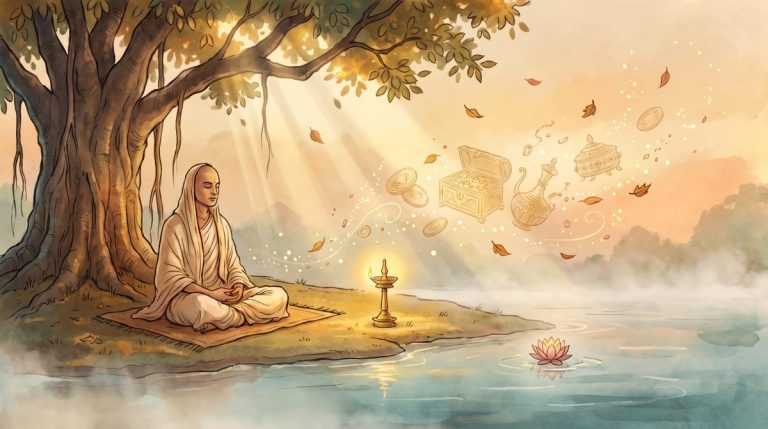
There are two fundamental ways to relate to the things we possess—whether material, intellectual, or relational. The first is ownership: “This is mine. This achievement is mine. This relationship is mine. This knowledge is mine.”
When we operate from ownership, we become brittle. We grip tightly. We demand that these things remain with us forever and perform according to our expectations. And when they inevitably fail—when the promotion doesn't materialize, when the relationship evolves, when the knowledge becomes obsolete—we crumble.
The second way is trusteeship: acknowledging that nothing truly belongs to us. The knowledge we possess came through no effort of our own—we didn't create the concept of intelligence or the capacity to think. Our abilities are given. Our circumstances are given. Our lifespan is finite and unpredictable.
“My deeds and my intentions are mine.” This is a practical middle ground. While we don't truly own our abilities (which come from Ishvara, the governing intelligence of the universe), we do have responsibility for our choices and actions in the present moment.
Trusteeship means:
- I've been blessed with certain capacities, knowledge, and resources for a limited time
- My responsibility is to use these wisely, to the best of my ability
Freedom From Jealousy: The Insecurity at Our Core
Jealousy reveals something profound about how we construct our identity. It is the insecurity that arises when we fear something dear to us will be taken away. And underlying that fear is a deeper truth: our identity is contingent on external objects and relationships.
Consider this: You bring someone you care about to a social gathering. They strike up a conversation with someone else. Immediately, a story begins in your mind. The other person is “stealing” them from you. They're more interesting. They're a threat.
But wait. What actually happened? Two people had a conversation. That's all. The story you added is your projection—your narrative born from insecurity about your own worth.
As the teaching suggests: If you were truly self-assured, secure in your own quality and composure, what would there be to fear? If they chose to leave, it would be a reflection of their lack of discernment, not your insufficiency.
The solution to jealousy isn't to suppress it but to:
- Acknowledge the cause-effect relationship – The world operates according to predictable laws, not random cruelty. When something happens that threatens what you cherish, it's not personal.
- Recognize the illusion of control – You cannot force another person to stay, think, or feel what you want them to feel.
- Use it as inspiration – Rather than spiraling into “I'm not good enough,” say: “Interesting. I feel competitive. Let me use this as motivation to refine my own life, skills, and presence.”
This transforms jealousy from a destructive emotion into feedback—information about where we need to grow.
The Binding Action vs. The Free Action
Krishna distinguishes between two types of actions: binding actions and non-binding actions.
A binding action is one where you are driven by compulsion. The person who “must” defend themselves every time they're criticized. The person who “must” know if someone is upset with them or they can't function. The person who “must” win an argument, achieve success, or experience peace 24/7.
Notice the common element: “I have to. I have to. I have to.”
These actions are binding because they:
- Narrow your vision of what's possible
- Create stubbornness over time
- Reduce your options and flexibility
- Represent a pressure to please the displeased “I” in the moment at the expense of the well-being of your future self
If you continuously eat a cake to satisfy an immediate craving, you might feel good for five minutes. But what about the “you” of five years from now—the one with a weakened body and degraded mental sharpness?
The root of binding actions is this: The pressure to please the displeased me right now is greater than my consideration for the well-being of the future me.
How We Ruin Our Lives: A Formula
The formula for slowly ruining your life over decades is remarkably simple:
- Set unrealistic expectations – “I have to win this argument or else I'm a failure.” “I have to earn this promotion or else my life has no meaning.”
- Act from binding likes and dislikes – Ignore all other options. Narrow your vision to only one path forward.
- Blame external circumstances when things don't work out – “It's the world's fault. It's that person's fault. It's the economy's fault.”
- Develop a split personality – Show one face to the world (composed, professional, gracious) while internally blaming and resenting.
- Repeat this cycle daily – Over time, you become increasingly rigid, bitter, and limited in your capacity to respond creatively to life.
The tragedy is watching people who have been generous their entire lives—serving, giving, following spiritual principles—suddenly turn bitter in their later years because their giving was contingent on receiving recognition or reciprocation.
Interrupting the Pattern: The Question “Now What?”
How do we interrupt this self-destructive pattern?
Krishna offers a elegant solution: Ask yourself “Why?” and then “Now what?”
When you find yourself powerfully attracted to something or driven to achieve something, pause and ask:
- Why? What is the actual motivation beneath this desire?
- Suppose I have it right now. Then what? What changes? How does my life transform?
- Now what? After the initial satisfaction, what comes next? Is the situation as exuberant as I imagined?
This mental exercise punctures the fantasy that our mind creates. We realize that acquiring the thing we want won't solve the fundamental dissatisfaction we feel.
The Practice of Self-Introspection
Krishna constantly encourages Arjuna to leave the Himalaya—the retreat, the safe place—and return to Kurukshetra, the field of action. Why? Because it is only in the messy, complicated world of action that we can make mistakes, receive feedback, and refine ourselves.
The practice is simple:
- Make a choice. Act.
- Experience the result. Observe what happens.
- Open one of two doors:
- Door One (Blame): “This didn't go as planned. It's someone else's fault.”
- Door Two (Self-Introspection): “This didn't go as planned. What could I have done differently? What will I do next time?”
Each time you open Door Two, you refine your decision-making process. Each time you open Door One, you remain trapped in your own limitations.
The beauty is that even the process of self-introspection—regardless of the outcome—develops new strength and resilience that transfers to other areas of life.
The Role of Gratitude: The Hidden Abundance
While we're obsessed with what we lack, we remain blind to what we already have.
Right now, as you read this:
- You are breathing air
- You have consciousness
- You likely have a roof over your head
- You have the capacity to think, learn, and grow
These are not small things. In the context of the entire universe and the billions of people struggling for basic survival, these are extraordinary gifts.
The wisdom is this: Rather than asking “How can I get more?” ask “How can I do the best with what I've already been given?”
This shift alone—this simple reorientation of gratitude—dissolves much of the suffering we create through our complaints and comparisons.
Life in Modern Complexity
One caveat: The wisdom of the ancient Rishis was developed in a world of remarkable simplicity compared to ours. Five thousand years ago, there was no media, no endless options, no constant comparison to others' highlight reels.
Today, we face unprecedented complexity. Our mental burden is far heavier than that of those ancient sages. We are asked to be equanimous and peaceful in a world of constant stimulation, infinite choices, and relentless comparison.
This is worth acknowledging: You are surviving and doing very well in an extraordinarily complex time.
The challenge, then, is not to become like a Rishi of ancient times, but to preserve the essential wisdom while adapting it to the modern context. This requires:
- Feeding your mind consistently with healthy information
- Understanding that discipline and practice are non-negotiable
- Accepting that if you can find time to scroll social media for an hour, you can find 20 minutes to engage with wisdom
- Recognizing that this is a lifelong, active process—not a one-time achievement
The Path Forward: Karma Yoga
All of this culminates in what Krishna calls Karma Yoga—the yoga of action.
A karma yogi is not someone who has eliminated action. Rather, it's someone who has fundamentally reoriented their relationship to action. They have realized:
- I'm not here to get entangled with outcomes. I'm here to discover truth.
- My actions aren't meant to please a dissatisfied I. They're meant to mature me, develop me, and build character.
- Every action is an opportunity for self-inquiry. How can this action help me understand myself better?
- Results aren't my responsibility; they're Ishvara's domain. My responsibility is to do my duty well.
This is not passivity. It's passionate engagement with life coupled with equanimity regarding results.
Conclusion: The Freedom in Acceptance
“Life isn't here to make you happy.”
When you truly accept this not intellectually, but in the depths of your being something miraculous happens. You are freed.
You stop waiting for life to deliver happiness and start building it yourself through the quality of your choices, your character, and your consciousness.
You stop blaming the world for your suffering and take responsibility for your own maturation.
You stop gripping tightly to people and possessions and learn to hold them lightly, appreciating them while they're here and letting them go when they depart.
Most importantly, you stop expecting life to be other than it is. And in that acceptance, you discover something that happiness can never provide: peace.
The book “Freedom from Disappointment” begins with this first sentence. The rest of the pages are yours to write—not by trying to make life conform to your expectations, but by learning to navigate life as it actually is.
That is the wisdom. That is the freedom. That is the way forward.
“Based on the teachings of Andre Vas”