Understanding the Waves That Are Not You
We tend to imagine the mind as a single, continuous field—a seamless stream of thinking, feeling, remembering, imagining. It appears unified, solid, and deeply personal. But Vedanta offers a far more precise and transformative view.
What we call “the mind” is not a monolithic entity. It is a constant succession of momentary appearances. A thought flares up, lingers briefly, and dissolves. An emotion surges and fades. A memory flashes across awareness. An image forms and disappears. None of these movements are permanent. None endure beyond the conditions that give rise to them. They come and go like weather passing through the sky.
Vedanta calls each of these movements a vritti (vṛtti)—a modification of the mind, a wave arising on the surface of awareness.
This simple insight carries profound implications. If the mind is a series of changing movements, and you are the one who knows those movements, then you cannot be the mind.
A vritti is known.
The knower is not.
The Meaning of Vritti
The word vritti comes from the Sanskrit root vṛt—“to turn, revolve, arise, take form.” A vritti is any mental formation: a thought, emotion, sensation, memory, perception, or mental image arising in the antahkarana (the inner instrument).
Each vritti has a beginning and an end. It appears, abides briefly, and resolves.
Because it is experienced—because it is known—it cannot be the Self. The Self, in Vedantic understanding, is that which knows. It is the unchanging awareness in whose presence all mental movements occur.
This distinction between the witness and the movement is foundational to Vedantic inquiry.
Scriptural Foundations
The concept of vritti is most famously articulated in the Yoga Sutras of Patanjali, which opens with the definition: “Yoga is the cessation of the modifications of the mind” (citta-vritti-nirodhaḥ).
In Vedanta, however, the aim is not cessation but understanding.
The Upanishads distinguish the unchanging witness (sakshi) from the changing mind. Texts such as the Vivekachudamani and Panchadashi explain how knowledge itself occurs through vrittis: the mind takes the “form” of what it knows. Even the Bhagavad Gita describes the mind as restless (chanchala), pointing to its constantly shifting nature.
Across these texts, one theme is consistent: the mind moves; the Self does not.
How Knowledge Happens
In Advaita Vedanta, a vritti forms in response to an object. When you see a tree, the mind assumes a “tree-shaped” modification. Consciousness illumines that modification, and knowledge occurs. This is called vritti-jñāna—knowledge through mental modification.
Even Self-knowledge operates through a special kind of vritti, called akhandakara-vritti, the cognition that removes ignorance about one’s true nature. After ignorance is destroyed, the mind may continue functioning—but confusion about identity does not.
Thus, vrittis are not obstacles. They are instruments.
The Three Qualities of Mental Movement
Vrittis reflect the predominance of the three gunas—the fundamental qualities of nature:
- Tamas: dullness, heaviness, inertia
- Rajas: agitation, restlessness, emotional turbulence
- Sattva: clarity, calmness, balance
A depressed state reflects tamasic vrittis. Anxiety reflects rajasic vrittis. A clear, reflective mind reflects sattvic vrittis.
Yet from the standpoint of awareness, all three are equally objects. None define the Self.
Where Bondage Begins
A vritti in itself is harmless.
Anger arises. Sadness appears. Joy moves through the system. These are natural mental events—responses shaped by conditioning, memory, and perception. They are not moral failures or spiritual defects.
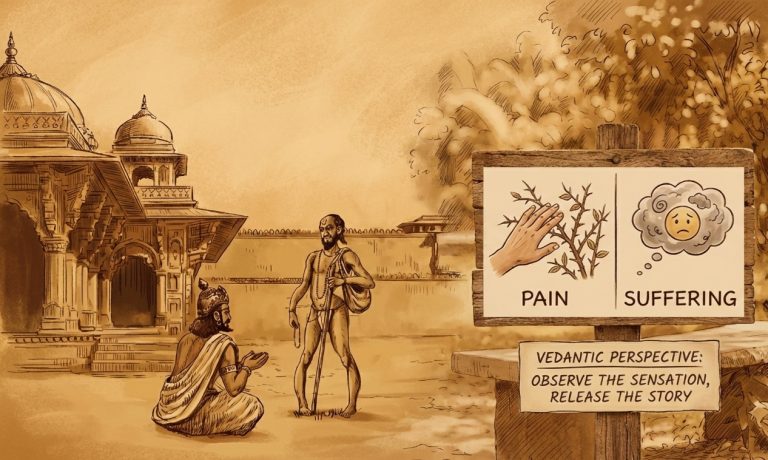
Bondage begins not with the vritti, but with identification.
When anger arises and the thought “I am angry” is believed, the wave becomes identity. When sadness appears and the mind declares “This is me,” the transient becomes personal. When pleasure is clung to or discomfort resisted, the next wave is already forming.
Vedanta’s insight is radical in its simplicity:
Vrittis do not bind. Identification binds.
To see a thought as a thought is freedom.
What Liberation Is—and Is Not
A common misunderstanding is that spirituality requires stopping thought. That is the emphasis of classical Yoga, where the stilling of mental modifications is the goal.
Vedanta takes a different approach.
Liberation is not the elimination of vrittis. It is the recognition that no vritti has ever been you.
The mind may remain active. Emotions may arise. Perceptions may continue. What ends is confusion about identity.
A quiet mind is beneficial—it is sattvic and conducive to clarity—but silence itself is not liberation. Knowledge is liberation: knowledge that the Self is the unchanging witness of all mental movement.
The wave may rise and fall. The ocean is undisturbed.
The First Step Toward Freedom
To understand vritti is to understand the nature of the mind.
To understand the nature of the mind is to stop mistaking it for yourself.
This shift is subtle but transformative. Instead of “I am anxious,” there is “anxiety is present in the mind.” Instead of “I am joyful,” there is “joy is arising in the mind.” The grammar changes—and with it, the sense of self.
The mind continues its dance. Thoughts form and dissolve. Emotions surge and recede. But awareness—the light in which all of this appears—remains unchanged.
In that recognition, even the rise and fall of vrittis becomes effortless.
They are seen for what they are: waves on the surface of awareness, never touching its depth.
And that clarity is the beginning of freedom.
“Based on the teachings of Dr. Tina Ramapdarath”