Introduction to Vedanta: The Ancient Path to Liberation
What Is Vedanta?
The word Vedānta comes from Sanskrit, meaning the “final part” (anta) of the four Vedas — the ancient scriptures of India. While the earlier portions of the Vedas are largely dedicated to prayers and rituals, the concluding sections focus on profound spiritual wisdom discovered by ancient sages known as ṛṣis. These concluding texts are called the Upaniṣads, and together with related scriptures like the Bhagavad Gītā, they form the body of teaching known as Vedānta.
From the standpoint of spiritual practice, Vedānta is understood as mokṣa śāstra — scriptural teachings that lead to liberation. That liberation, or mokṣa, means freedom not only from the cycle of rebirth but, more immediately, freedom from suffering here and now.
Simply put, Vedānta is a solution to the problem of human suffering.
The Problem: Pain vs. Suffering
Before exploring Vedānta's solution, it is important to understand the problem it addresses. Everyone experiences physical and emotional pain. But is it possible to be completely free from suffering? And if so, would that not leave us dangerously numb to the world around us?
Vedānta draws a crucial distinction between pain and suffering:
- Pain is a basic physical or emotional feeling — a warning system that draws our attention to problems requiring care.
- Suffering is the distress and anguish that arises in response to pain — the tormented inner reaction that makes an already difficult experience even more unbearable.
When you have a splitting headache, the throbbing sensation is pain. But the anguished thought, “When will this awful throbbing stop? Why does this always happen to me?” — that is suffering.
Remarkably, Vedānta teaches that pain is inevitable, but suffering is optional. It is entirely possible to experience pain without the accompanying distress. A simple example illustrates this. When you watch a deeply moving film and cry during a heartbreaking scene, you feel real sadness and shed real tears — yet you do not suffer. You do not cry out, “Why did this happen to me?” You remain fundamentally okay. In fact, you may even enjoy the sadness of the film.
The reason you do not suffer during a movie is that the events on screen do not truly affect who you are. And this, the ancient ṛṣis discovered, points to a profound truth: the essence of who you truly are is utterly unaffected by pain.
The Root Cause: Self-Non-Recognition
If the source of happiness lies within us, why do we spend our lives desperately seeking it outside ourselves? Vedānta identifies the root cause of this misdirected search as self-non-recognition — the failure to recognize your true nature as full, complete, and the very source of happiness.
This is beautifully illustrated in the classical Daśama (Ten Men) Story. Ten young students (brahmacārīs) swimming across a river each counted the others after crossing safely but forgot to count themselves. Each found only nine, and they spent hours frantically searching for their “missing” classmate. A passerby, seeing all ten standing before him, finally pointed to one and said, “You counted nine, but you forgot to count yourself. You are the tenth.”
In just the same way, we fail to recognize our own inner completeness. Feeling deficient and incomplete, we endlessly seek happiness in objects, relationships, achievements, and experiences — all outside ourselves. Yet just as the tenth man was never truly missing, the happiness we seek was never truly absent. It lies within us, always.
The True Self: Sat-Cit-Ānanda
The ancient ṛṣis used three Sanskrit words to describe the true self, or Ātmā:
- Sat — That which is real and exists unconditionally. Ātmā is timeless, eternal, unborn, and uncreated.
- Cit — Pure consciousness or awareness. Unlike insentient objects such as rocks and clouds, you have the power to know, feel, and experience. This knowing capacity is your essential nature.
- Ānanda — Often translated as “bliss,” but more accurately understood as the inner source of happiness — the true fullness and contentment that lies within you.
Together, Sat-Cit-Ānanda means that Ātmā is an eternal, conscious being that is the true source of happiness.
One of Vedānta's most important teachings concerns the precise meaning of consciousness. In this tradition, consciousness is not alertness or attentiveness — those are qualities of the mind. Nor is it something you possess, like a car or a body. A possession is something you can lose, and yet you continue to exist without it. But you cannot exist without consciousness. Therefore, you do not have consciousness — you are consciousness. This distinction is foundational to everything that follows.
Independence from Body and Mind
Ātmā and the Body
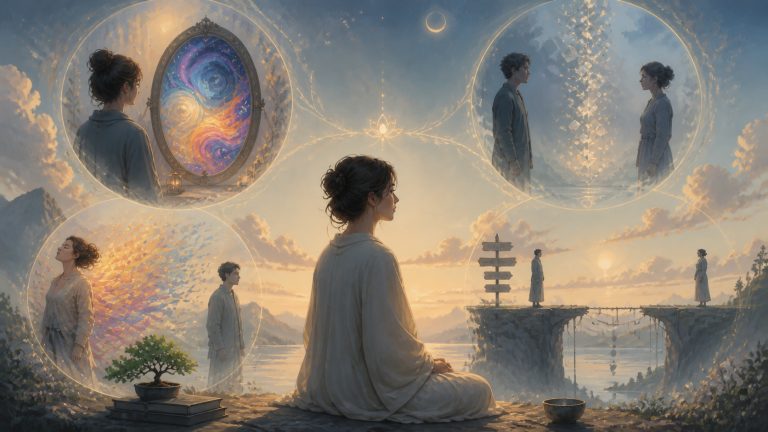
Using the powerful teaching method of Dṛg-Dṛśya Viveka — distinguishing the seer (dṛg) from the seen (dṛśya), the knower from the known — Vedānta demonstrates that anything known to you as an object is necessarily different from you, the knower.
Your body is an object known to you, just as a table or a piece of cloth is known to you. The hardness of a table belongs to the table, not to you. Similarly, the gender, age, and health of your body belong to your body — not to the conscious being you truly are. The apparent confusion arises only because the body is permeated by the sense of touch, creating an illusion of identity. But if your entire body were numb, you would feel no more connected to it than to a piece of furniture.
This discovery leads to a healthy detachment toward the body. This is not indifference or apathy. Detachment is a state of objectivity — clear thinking in which you understand your body to be a precious gift entrusted to your care. With detachment, you can actually take better care of your body, freed from the anxiety and despair that often impair both judgment and healing.
Ātmā and the Mind
Even subtler and more insidious than body identification is the confusion between Ātmā and the mind. All mental activities — perceptions, thoughts, and emotions — arise in your mind as vṛttis (mental modifications) and are known to you, the conscious observer. Since they are known to you, they are necessarily objects, and you are their subject.
The activities of your mind are in a constant state of flux. Perceptions change, thoughts arise and dissolve, emotions surge and subside. But for you to accurately observe this constant change, you yourself must be unchanging. Just as you cannot perceive the speed of a car moving at your own speed unless you stand still on the roadside, only as an unchanging conscious observer can you perceive the constantly changing contents of your mind.
Vedānta uses the beautiful metaphor of a clear crystal placed near an orange cloth. The crystal appears orange because of its proximity to the cloth, yet it remains perfectly clear. In exactly the same way, emotions like sadness, anger, and fear appear to “rub off” on consciousness due to their close proximity — yet consciousness remains utterly unchanged and unaffected.
This insight — that you as the conscious observer are completely unaffected by all the perceptions, cognitions, and emotions that arise in your mind — is among Vedānta's most liberating revelations.
To make this knowledge experientially clear and free from doubt, Vedānta employs meditation. A simple mantra meditation practice can produce brief moments of mental silence — a gap in which no vṛttis arise. In that gap, just as a crystal removed from orange cloth is clearly seen to be perfectly clear, you can directly discover that consciousness remains pristine and unaffected. Even a few moments of such clarity is enough to confirm this truth beyond doubt.
The Three States and the Boundless Nature of Consciousness
Vedānta deepens this inquiry by examining your three daily states of experience:
- Jāgrat — The waking state, in which you observe perceptions, cognitions, and emotions as vṛttis produced by your interaction with the world.
- Svapna — The dream state, in which your senses are inactive yet you continue to perceive people, places, and events produced from memory.
- Suṣupti — Deep dreamless sleep, in which all vṛttis cease entirely.
Crucially, Vedānta teaches that you remain conscious even in deep sleep. Consciousness does not “switch off” during sleep like a refrigerator light. The unchanging consciousness that illumines all vṛttis during waking and dreaming also illumines their complete absence during deep sleep. You remain present as awareness, observing a perfectly still mind — like standing in a perfectly black room with your eyes wide open, seeing nothing but remaining fully present.
Furthermore, consciousness has no dimensions — no height, no width, no edge or boundary. Whatever is dimensionless is limitless, and whatever is limitless is all-pervading. The ancient ṛṣis described this one infinite consciousness as hidden within all beings, illumining each individual mind like the sun illumining the world. Just as the same sun is reflected in countless lakes, rivers, and oceans — each reflecting the same light in its own unique way — one all-pervading consciousness is reflected in countless minds, giving rise to the experience of individual conscious beings.
You as the conscious observer are known in Vedānta as the Sākṣī — the awareful witness. The Sākṣī is the silent, unchanging presence that witnesses all three states: the active world of waking, the inner world of dreams, and the serene stillness of deep sleep.
Īśvara: The Source of the Universe
Having explored the nature of the inner self, Vedānta turns outward to ask: What is the universe? Where did it come from? And how are we related to its source?
Vedānta's approach to these questions is unique among spiritual traditions. Unlike Western religions — where God is primarily a matter of blind faith, accepted on the authority of scripture alone — Vedānta never severs scriptural revelation from reason. The great scholar Ādi Śaṅkarācārya famously declared: “If a hundred scriptures say that fire is cold or dark, none of those scriptures can be accepted as authoritative.”
In Vedānta, the word śraddhā, often translated as “faith,” is better understood as trust in anticipation of personal verification. Scripture is trusted as a reliable guide — much as you would trust a guidebook before visiting a foreign city — but the goal is not belief. It is personal, direct knowledge.
The source of the universe is called Īśvara — the first cause, the uncaused cause. Something cannot come from nothing, and the universe is something. Therefore, it must have arisen from something. That something is Īśvara.
To understand Īśvara's nature, Vedānta distinguishes between two kinds of cause:
- Upādāna Kāraṇa — the material cause: the fundamental stuff from which something is made (clay in the case of a pot).
- Nimitta Kāraṇa — the efficient cause: the intelligent agent that produces the effect (the potter).
Vedānta demonstrates that Īśvara is both causes simultaneously. The spider metaphor from the Muṇḍaka Upaniṣad captures this elegantly: a spider produces silk from its own body and weaves an intricate web from that silk. It is both the intelligent creator and the very substance of the web. Similarly, Īśvara is both the intelligent creator of the universe and the fundamental material out of which the universe is woven.
But the most illuminating metaphor is that of a dream. When you dream, you are both the intelligent creator of your dream world and its very substance — every person, building, and landscape in your dream is made of your own consciousness. Your dream world is utterly non-separate from you. In the same way, the universe is utterly non-separate from Īśvara. Every particle and atom in the universe is made of Īśvara.
Īśvara's creative power is known as Māyā — the mysterious capacity through which the infinite appears as the finite, the one appears as the many, and the formless takes on countless forms. Īśvara wields Māyā as the Nimitta Kāraṇa — the intelligent agent of creation — while simultaneously being the Upādāna Kāraṇa — the very substance of all that is created.
Īśvara is thus the Sṛṣṭikartā (creator), Sthitikartā (sustainer), and Layakartā (dissolver) of a cyclic universe — a universe that, like the spider's web, is perpetually woven, maintained, and drawn back into its source in an endless cycle of manifestation and dissolution.
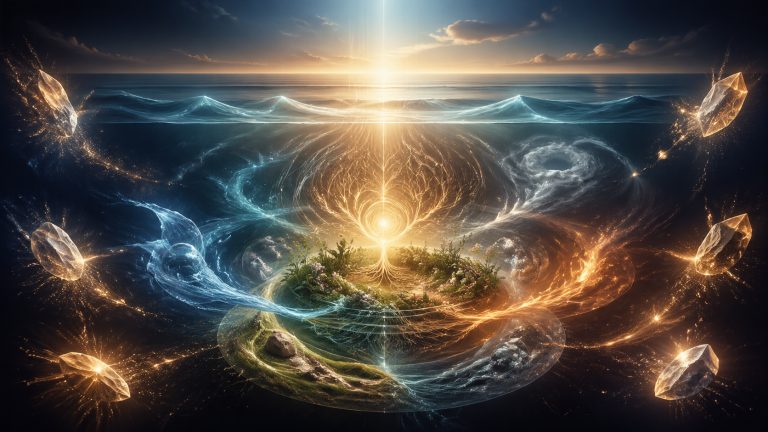
This means Īśvara does not merely pervade the universe as water fills a pot. More accurately, the universe exists within Īśvara, just as a room exists within limitless space. This truth is celebrated in the Puruṣa Sūkta of the Yajurveda: “Having completely pervaded the universe, he remained beyond it.”
Tat Tvam Asi: That Thou Art
We now arrive at the culminating insight of Vedānta — the profound Mahāvākya (great statement) from the Chāndogya Upaniṣad:
Tat Tvam Asi — “That Thou Art”
This statement reveals the ultimate relationship between the individual self and Īśvara. The ocean metaphor captures it beautifully. Every wave in the ocean, large or small, is made entirely of water. The ocean itself is also water. Both wave and ocean are utterly different in form — one enormous, one tiny — yet they are one in essence, because both are nothing but water.
In the same way, you and Īśvara are utterly different in form, yet one in essence. The essence because of which Īśvara exists and the essence because of which you exist are one and the same. That non-dual, absolute reality is what Vedānta calls Brahman.
- Tat — That: the essence because of which Īśvara and the universe exist.
- Tvam — Thou: you, the individual conscious being.
- Asi — Art: you are that same essence.
The apparent separation between the individual Ātmā and the infinite Brahman is a product of Avidyā — ignorance — like mistaking a rope for a snake in a dimly lit alley. When the light of Jñāna (knowledge) dispels that ignorance, the truth stands revealed: there is only one reality, one consciousness, one existence. This is the vision of Advaita Vedānta — non-dual Vedānta — as expounded by Ādi Śaṅkarācārya.
The Path Forward: Ātma Vicāra
The discovery of this truth does not happen by merely reading about it or accepting it on faith. It requires a direct, personal inquiry known as Ātma Vicāra — self-inquiry. Vedānta's greatness lies not only in what it teaches but in how it teaches — through a meticulous, step-by-step methodology that leads the sincere student from intellectual understanding to direct experiential knowledge.
This process involves:
- Śravaṇa — Listening to and studying the scriptures under a qualified teacher (guru)
- Manana — Reflecting deeply on what has been taught, resolving all doubts through reason
- Nididhyāsana — Sustained contemplation and meditation that transforms intellectual understanding into direct, lived knowledge
- Dṛg-Dṛśya Viveka — The ongoing practice of distinguishing the seer from the seen, consciousness from its contents
When the veil of Avidyā (self-non-recognition) is finally lifted — when you truly discover your nature as the eternal, unchanging, all-pervading consciousness — the result is Mokṣa, liberation. Not a future event in some distant heaven, but a present reality. A freedom from suffering that arises here and now, in the recognition that you are, and have always been, full, complete, and utterly at peace.
Conclusion
Vedānta offers one of humanity's most profound and systematic explorations of the nature of the self, the world, and their ultimate source. It does not ask you to blindly believe. It invites you to inquire, to reason, to meditate, and ultimately to personally discover what the ancient ṛṣis discovered thousands of years ago:
That the true source of happiness lies within you. That you are Cit — consciousness itself — unborn, unchanging, unlimited. That you and the universe and Īśvara are, in essence, one. That the wave and the ocean are, at their core, nothing but water.
Tat Tvam Asi — That Thou Art.
This is the vision of Vedānta. And it is available to anyone willing to follow the path of Ātma Vicāra with an open mind, a sincere heart, and trust in the wisdom of the ancient ṛṣis who walked this path before us.
Based on the Teaching of Swami Tadatmananda